An Insurance Salesman and His Wife

In 1985, Russell "Rusty" Hardenburgh was an insurance salesman in Boardman Township, Ohio—a quiet suburb of Youngstown. He bought his first computer: a Tandy 1200, a straight XT-class machine with a 10 megabyte hard drive, for over $4,000. He bought it for his insurance business. What he found was a calling.
Rusty discovered modems. He discovered bulletin board systems. And he discovered that most of them were run by gatekeepers—power-tripping sysops who decided who got access, what you could download, and how long you could stay connected. He hated it.
His wife Edwina "Edie" had never touched a computer. But when Rusty told her he wanted to start his own BBS, she agreed on one condition: it would carry both their names.
On May 11, 1987, Rusty n Edie's BBS went live. The setup was humble: an IBM XT his employer had given him, a 20 MB hard drive (installed for $500), a 2,400 baud modem ($400), and a single phone line. The BBS software was Tcomm, a shareware program Rusty downloaded from another board. It had about 50 files available for download.
Six people called on the first day.
"No Censorship! No Rules! No Hassle! Have fun. End of rules."
— The official policy of Rusty n Edie's BBSBy December 1987, Rusty was averaging 10 calls a day and had switched to PCBoard—the commercial BBS software that he'd later call "the most flexible and wonderful BBS program there is." He added a second phone line and a 386 processor. Then demand exploded.
By June 1988, callers were getting busy signals constantly. People started donating money to help Rusty expand. The donations funded more modems, more phone lines, more hard drives. The machine was growing. And it wouldn't stop.
124 Lines in a Basement
What started as a single modem on a desk became something that needed its own house.
The Hardenburghs' apartment spare bedroom hit an estimated 120°F from the heat of the equipment. They bought a house in Boardman specifically for the basement space and moved the entire operation underground.
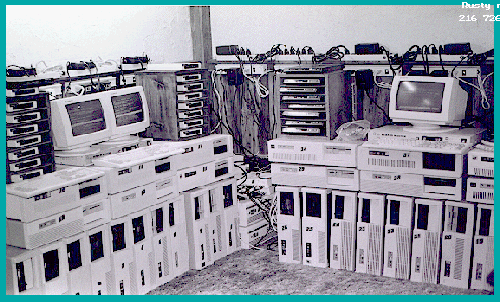
Look at that photo. Every beige box is a dedicated 286 computer with its own 30 MB hard drive—one for each simultaneous caller. They're numbered. There are 128 of them. Behind them, towers of hard drives, monitors, and a snake's nest of cabling. This is what a datacenter looked like before datacenters existed. This was someone's basement.
The Final Configuration (circa 1992)
| Component | Specs | Qty |
|---|---|---|
| Primary Servers | 486 DX 33 MHz, 32 MB RAM | 4 |
| Secondary Server | 486 SX 22 MHz, 80 MB RAM | 1 |
| Node Processors | 286 16 MHz (one per caller) | 128 |
| Additional Machines | 386 33 MHz (8), 386 16 MHz (1), 286 12 MHz (5) | 14 |
| Total Storage | 15 GB across 20 SCSI/ESDI drives | 20 |
| Per-Node Storage | 30 MB hard drive each | 128 |
| Network OS | Novell NetWare 386 | 4 copies |
| UPS Batteries | 16 KV total uninterruptible power | 10 |
| Cooling | 4-ton commercial AC unit | 1 |
| Humidity Control | Industrial humidifiers (static prevention) | 3 |
The Modem Bank
| Modem | Speed | Count |
|---|---|---|
| US Robotics | 14,400 baud | 58 |
| Anchor | 2,400 baud | 25 |
| Compucom | 9,600 baud | 24 |
| CONNECT-USA direct | Various | 16 |
| Hayes V-Series | 9,600 baud | 5 |
Each green dot = one active modem line
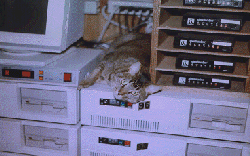
The entire family worked the operation: Rusty, Edie, their two sons, their daughter, and a full-time assistant sysop named Carl. Six people, managing what was effectively a small ISP out of a residential home.
"The system literally heated our home in the Ohio winters."
— Russell HardenburghWhat It Was Like to Call
You picked up the phone. You set your terminal program—Telix, Procomm Plus, maybe the built-in terminal in Windows 3.1. You dialed one of the Youngstown numbers. If you were lucky, a modem picked up. You heard the handshake—that screaming, warbling negotiation between two machines—and then you were in.
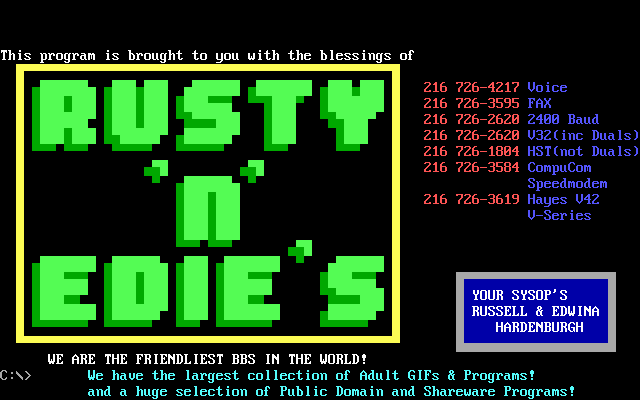
That screen is real. That's what greeted you. The sysops' names—Russell & Edwina Hardenburgh—right there in the corner. Seven different phone numbers depending on your modem speed. And the pitch, right on the front door: the largest collection of adult GIFs and programs, plus public domain and shareware. No ambiguity about what this board was for.
After login, you landed in PCBoard's main menu. PCBoard was the commercial BBS software of choice for large multi-line systems—it supported multiple simultaneous callers by running a separate copy of the program on each of those 128 node machines, networked through Novell NetWare. Single-key commands navigated you through file areas, message boards, online games, and chat rooms.
The file areas were the main attraction. Shareware, freeware, utilities, games—lots of games. The latest releases from Sierra, EA, Microprose, and anyone else publishing DOS software would appear on the board. Some of it was legitimate shareware. A lot of it wasn't.
Then there was the adult content—GIF images scanned from magazines, amateur uploads from subscribers, and a library that grew to over 5 gigabytes. In an era when a hard drive held 40 MB, that was staggering. This was years before the web. If you wanted images on a screen, you dialed a BBS.
Beyond the files, there were active message boards and real-time chat with up to 124 people simultaneously. You could page the sysop at any hour and Rusty or Edie would actually answer. They published their home phone number, their mailing address, and their fax number.
"You had something in common with anyone on the BBS just by virtue of being on a BBS. It was a place where you felt like you were home."
— Former caller, via Hacker NewsFor a kid going over to his friend's house after school, firing up the modem, and watching filenames scroll by at 14.4 kbps? It was everything.
60,000 Files and an Open Secret
Let's be honest about what Rusty n Edie's was. Yes, it was a community. Yes, it had message boards and chat and online games. But the reason 14,000 people paid $89 a year and racked up long-distance phone bills to dial into Youngstown, Ohio was the files.
Subscribers came from across the United States, Canada, and Europe. They were paying long-distance charges on top of the $89 membership. A caller from California downloading files from Ohio at 14,400 baud could rack up a phone bill that dwarfed the membership fee. People did it anyway.
How BBS Piracy Worked
The warez scene of the late '80s and early '90s had a hierarchy. At the top were the suppliers—people with access to commercial software before or at release who'd crack the copy protection and upload clean files. Then came the elite BBSes—invite-only boards that served as first-stop distribution. Below that were public boards like Rusty n Edie's, where the files trickled down to the masses. And at the bottom were the leeches—people who only downloaded and never uploaded, universally despised. The culture demanded contribution.
Rusty n Edie's sat in that public tier. It wasn't an elite warez board—it was too big, too open, too friendly for that. But the pirated software was there, mixed in with the legitimate shareware. The "No Rules" philosophy meant nobody was policing what got uploaded.
The Enemies They Made
Rusty and Edie had a specific habit that made them unpopular with other sysops: they'd download adult GIF images from other BBSes, strip out the original board's promotional text, and replace it with their own branding before reposting. This was considered deeply uncool in BBS culture.
When the hammer eventually fell, the community's reaction was telling: nobody came to their defense. Many sysops quietly smirked. Some applauded.
Meanwhile, the Software Publishers Association (SPA)—the trade group representing companies like Microsoft, Adobe, and Lotus—had been watching. They'd launched the "Don't Copy That Floppy" campaign in 1992. They were filing two lawsuits a week. And they were looking for a big target.
A 124-line BBS making over a million dollars a year in subscription fees while hosting pirated software? That was exactly the trophy kill they needed.
January 30, 1993
It started with a tip. A software developer named Bob Fairburn contacted the Software Publishers Association about copyrighted software available on Rusty n Edie's. The SPA worked with the FBI on a months-long investigation. Agents went undercover. They paid the $89 membership. They dialed in, browsed the file areas, and downloaded copyrighted software. They documented everything.
And on the morning of January 30, 1993, they arrived at the Hardenburgh residence with a federal search warrant.
- All computers and servers (every 486, 386, and 286 in the basement)
- All 128+ modems
- All hard drives (15+ GB of files)
- Telecommunications equipment and LAN cabling
- Backup media and floppy disks
- Financial records
- Subscriber business records (14,000+ names and addresses)
The warrant alleged that the Hardenburghs illegally distributed copyrighted software to subscribers without permission of the copyright owners. Under federal copyright statutes, they each faced up to five years in prison and a $250,000 fine.
Rusty n Edie's was one of the first test cases for a new felony law on software piracy. The SPA wanted to make an example. The FBI wanted a clean bust. And the BBS community—60,000 boards across America serving 17 million users—watched in terror.
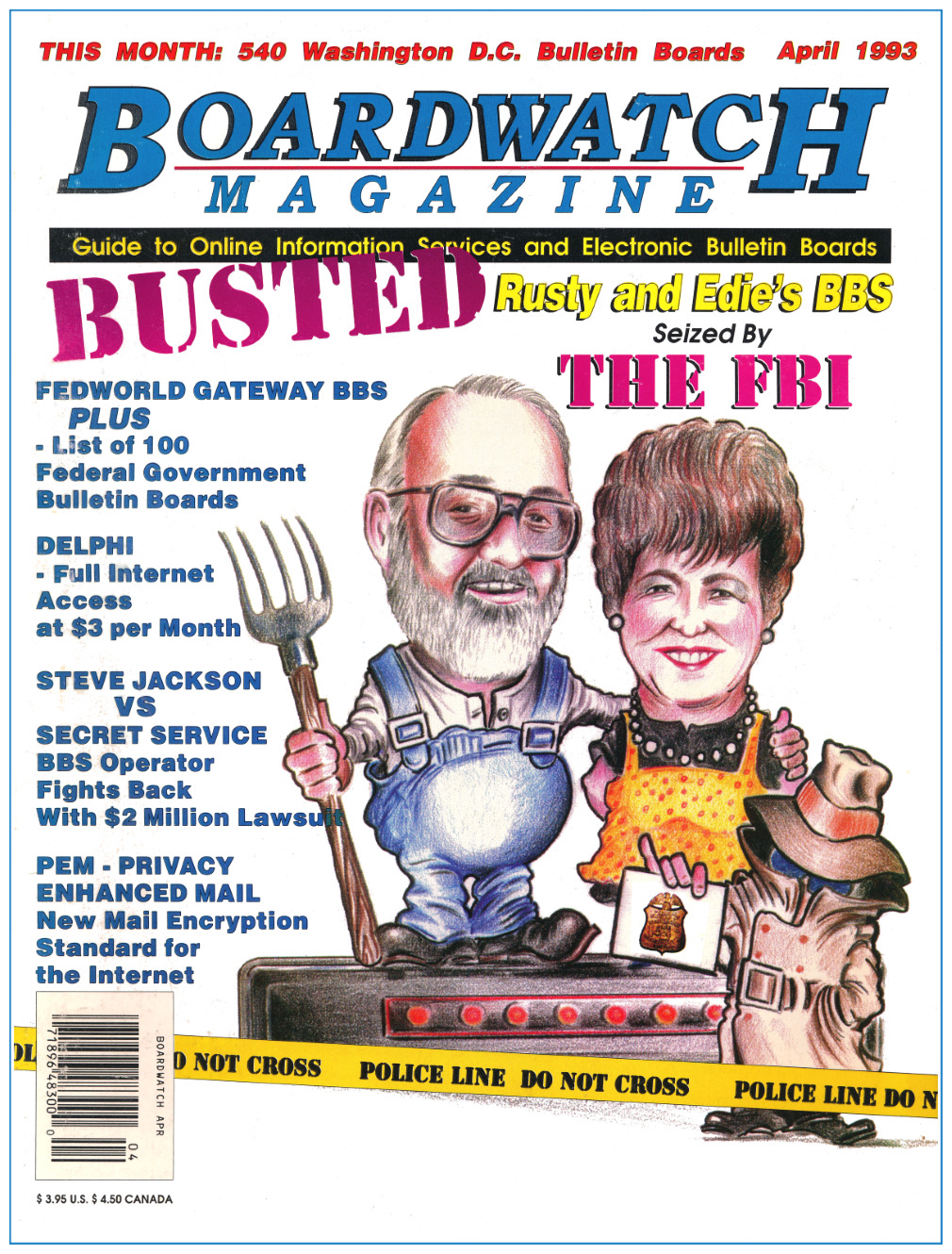
Boardwatch Magazine covered the raid extensively in their April 1993 issue. Hundreds of sysops wrote in asking permission to repost the articles on their own boards. If the feds could take down a 124-line board with 14,000 subscribers, nobody was safe.
"The SPA should protect the BBS operator from having equipment confiscated. These are computers, not drugs or illegal weapons!"
— John C. Dvorak, PC Magazine, May 11, 1993Dragged Through the System
The Criminal Case That Wasn't
Here's the part that stings. After the FBI seized $200,000 in equipment, after they took the subscriber records of 14,000 people, after they shut down a business that employed an entire family—the Hardenburghs were never charged with a crime.
The investigation dragged on for two years. No indictment. No charges filed. No trial. No conviction. The FBI took everything, and then… nothing. The equipment sat in an evidence locker. The phone lines went dead. The 14,000 subscribers found other boards or discovered this new thing called the World Wide Web.
The SPA got their headline. The FBI got their raid. And Rusty and Edie got destroyed without ever being formally accused of a crime.
The Playboy Lawsuit
Six weeks after the FBI raid, Playboy Enterprises filed a civil copyright infringement lawsuit—Playboy Enterprises, Inc. v. Russ Hardenburgh, Inc.—over 412 adult GIF images scanned from Playboy magazines and hosted on the BBS.
The case became a landmark in internet law. It predated the Communications Decency Act and Section 230 protections that would later shield platforms from liability for user-uploaded content. The central question: is the BBS operator liable for what subscribers upload?
The lawsuit ground on for five years. On February 3, 1998, the case was finally dismissed after a settlement was reached. By then, the BBS era was already over. The World Wide Web had made bulletin boards obsolete. But the question the case raised—platform liability for user content—would echo through every internet law debate for the next three decades.
The Timeline
What It All Meant
The raid on Rusty n Edie's in January 1993 is widely considered one of the markers of the end of the BBS era. Not because it killed BBSes directly—the web did that over the following two years—but because it showed every sysop in America that running an open board with "no rules" was now an invitation for federal agents to show up at your door.
BBSes that survived tightened their policies, monitored uploads, added disclaimers. The freewheeling anarchy of the dial-up era was over before the modems went cold.
The Legal Precedent
Playboy v. Hardenburgh became a cited case in the emerging field of internet law. The questions it raised—Is a platform liable for what users upload? Where does the operator's responsibility begin and end?—would define the next 30 years of technology regulation. The answers came in Section 230 of the Communications Decency Act (1996), which granted platforms broad immunity from user-generated content.
Too late for Rusty and Edie.
The SPA's Campaign
The Software Publishers Association pursued 245 audits and lawsuits in 1993 alone. Rusty n Edie's was their trophy kill—the biggest BBS they could find, taken down publicly to send a message. The SPA later merged into the Software & Information Industry Association, which continues anti-piracy enforcement today.
What It Was Really About
Rusty n Edie's wasn't special because of the piracy. Every BBS had pirated software. It was special because of the scale—124 lines, 14,000 subscribers, a family running an accidental datacenter out of their basement in Ohio. It was the American dream applied to the telephone network: a man and his wife, starting something small, watching it grow beyond anything they imagined, and getting crushed by forces they never saw coming.
For every kid who dialed in, downloaded a game, and spent the afternoon playing something they could never have afforded—Rusty n Edie's was a portal. A window into a world of infinite software, accessible through a phone line and a modem that screamed when it connected.
The 124 green lights in the basement went dark on January 30, 1993. They never came back on.
References
- Rusty n Edie's BBS — Wikipedia
- The Death of Rusty n Edie's — Vice (2022)
- Rusty n Edie's BBS — ipingthereforeiam.com (photos)
- Russell Hardenburgh — BBS Days
- Boardwatch Magazine, April 1993 — Internet Archive (full scan)
- Rusty n Edie's BBStro — Demozoo
- Rusty n Edie's Artifacts — Defacto2
- Playboy v. Hardenburgh, 982 F. Supp. 503 — Justia
- The Birth of Rusty N Edie's BBS — Hacker News
- PCBoard BBS Software — Wikipedia